



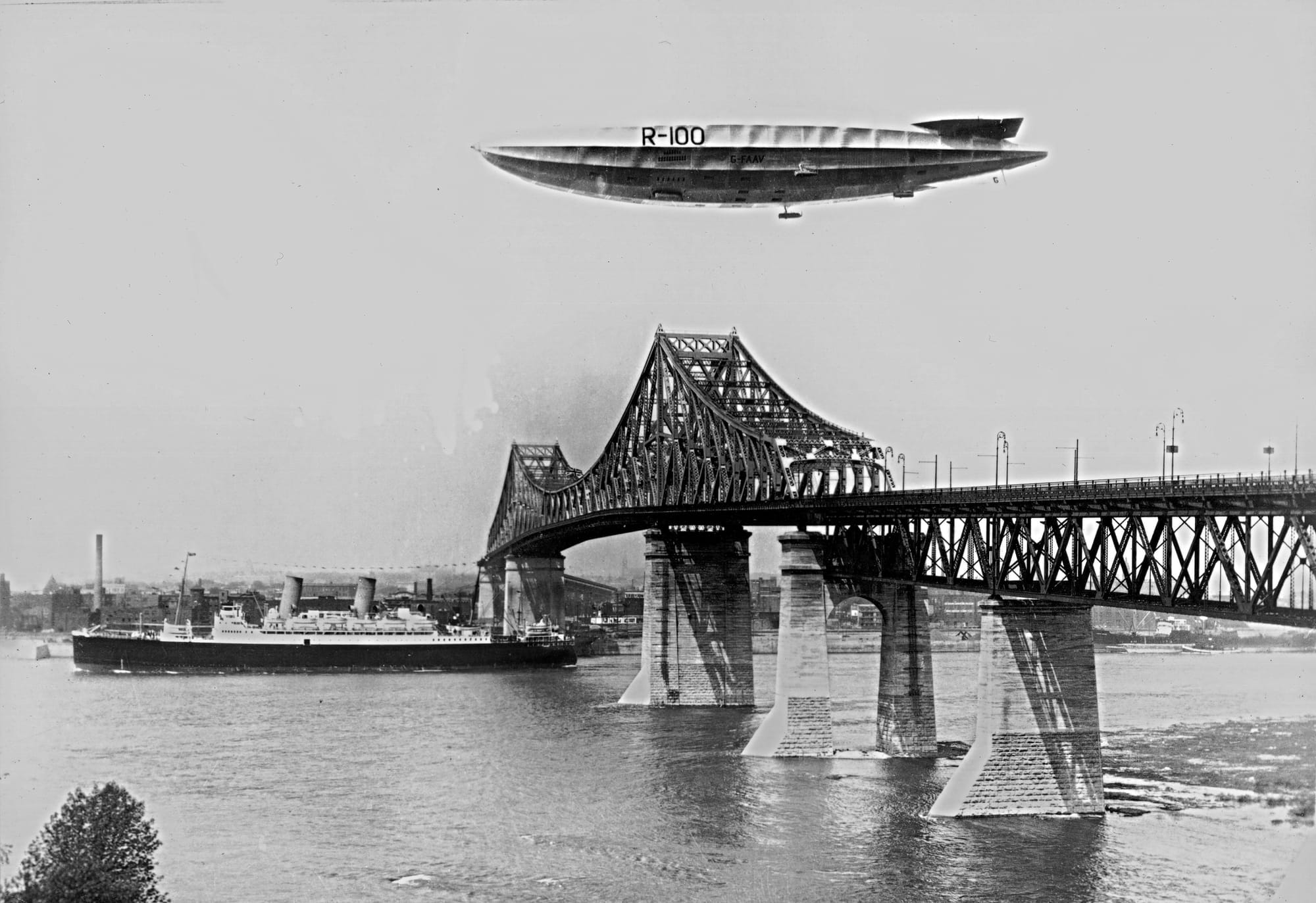
Hulking yet graceful, hydrogen-filled and cigar-shaped, the airship had a longer run in Montreal's imagination than most people realize. The city has been tangled up with lighter-than-air flight for a century and a half.
It starts on the evening of June 21, 1879, somewhere between 3,000 and 4,000 people packed into the lacrosse grounds at the corner of Sainte-Catherine Street and Hallowell Avenue (roughly where Westmount High School stands today) to watch the sewing machine repairman Charles Pagé attempt to change the history of aviation with a steerable flying machine he built.
Montrealers had been watching unmanned balloons drift across the sky for the better part of three decades — passengers of the wind, going wherever the atmosphere decided. Pagé had a different idea: a gondola roughly 1.4 metres wide and 2.2 metres long, built from wooden planks and hemp netting, equipped with paddle-wheel propellers borrowed conceptually from the St. Lawrence side-wheelers and a rudder system connected by steel cables to control levers. Wrist strength alone would drive it forward, backward, and sideways. He'd also argued from the start that the standard round balloon was the wrong shape — that a cigar-shaped envelope would cut through the air with far less resistance. Every major airship manufacturer that followed would arrive at the same conclusion.
For readers who care about Montreal
Create a free account to read this story and access 3 articles per month, plus our weekly Bulletin.


Comments
Welcome to The Main's comments section!
Share your thoughts and join the conversation. Please be respectful and constructive.
No comments yet. Be the first!