





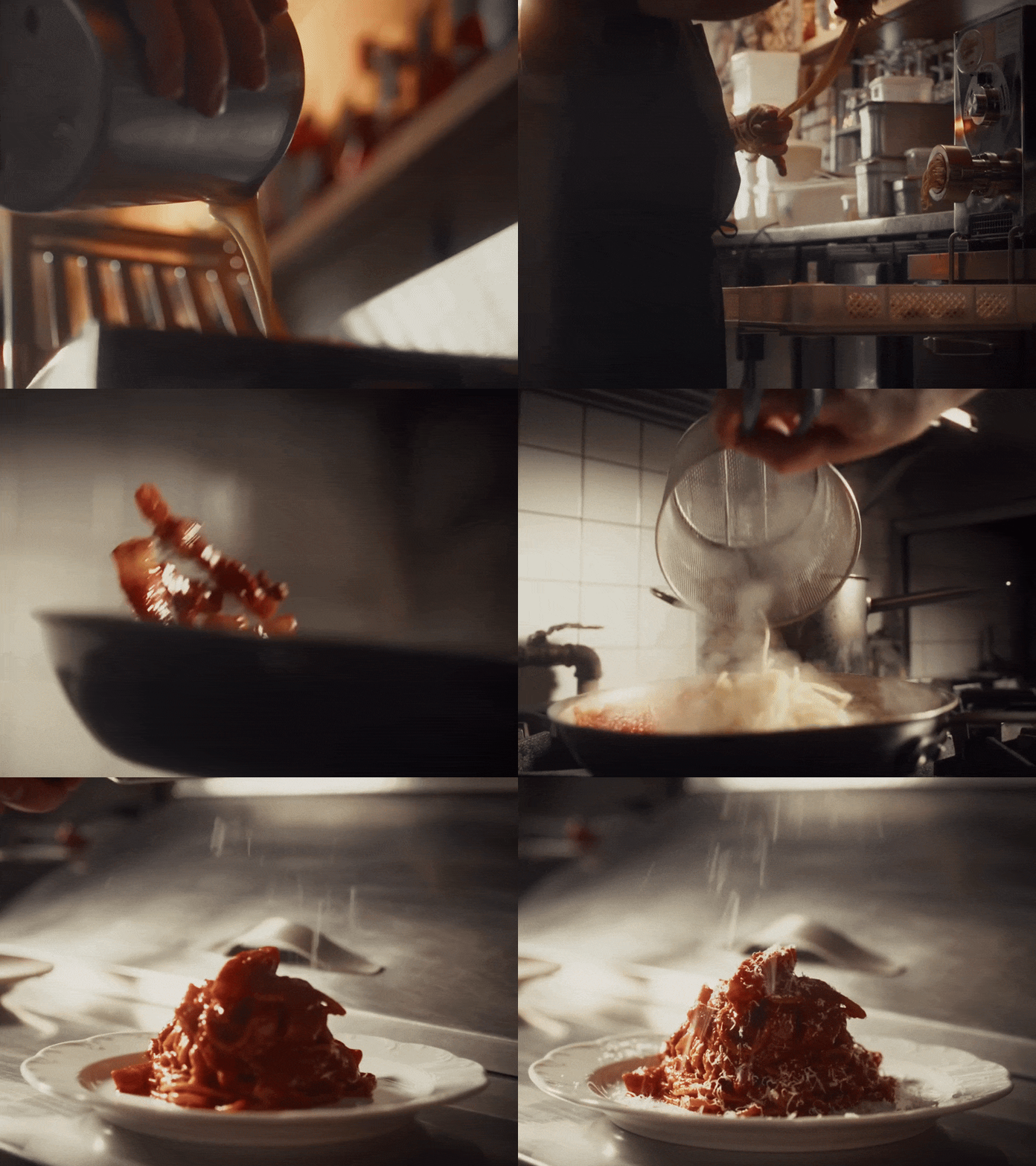


Mon Lapin's first cookbook, The Mon Lapin Cookbook: De Toute Beauté, is out October 7 from Phaidon, in English and French at the same time. Written by chefs Marc-Olivier Frappier and Jessica Noël and sommelier Vanya Filipovic with Montréal author Mireille Silcoff, it gathers more than 100 recipes from the Little Italy restaurant, with photographs are by Montréal photographer Dominique Lafond.
Phaidon's food list has always looked outward. The London-based house is behind books from elBulli and Noma, and Canadian kitchens have rarely made it onto the list. Before this one, the clearest precedent was Wildness, the 2019 book from Jeremy Charles of Raymonds in St. John's. That makes Mon Lapin the first Québec restaurant Phaidon has published and. The two books have more in common than a country. Charles turns up in Mon Lapin's pages too, as the friend who introduced the team to Newfoundland and to the squid in their tagliatelle ragù.
Like the restaurant, the book follows the seasons. It opens with "What Is a Wine Bar Anyway?", a chapter of the snacks that first put Mon Lapin's kitchen on the map, the croque-pétoncle among them. Then comes the year: "Steamy Windows in February" for winter, "The Fifth Season" for the spring run of snow crab, sea urchin and Matane shrimp, and "Every Vegetable Is a Summer Vegetable in Québec" for the province's short growing season.
Chapters on pasta, small animals and "Disco Desserts" follow, along with the house staples. Filipovic's wine essays run through every chapter, alongside a piece on hospitality, a page on the team's favourite Québec winemakers and a foreword by Montréal-born New York chef Riad Nasr. Each headnote carries a backstory, like where a dish came from, and who grew, caught or raised what goes into it.
Phaidon came calling
"I didn't even imagine a Mon Lapin book at that point," Frappier says of the day Phaidon got in touch. "We were busy doing other stuff. It's not like we didn't want to do a book. It just hadn't crossed our mind."
What’s more, "we have a lot of friends who do books, and even some experience in our past lives working with book releases, and it's quite rare that the two languages are released simultaneously," Filipovic says. "Usually you get one, and then you look for the translator or the publisher for the other language. So it was really cool that they were like, okay, we understand, we'll work with you for this goal."
Mon Lapin opened in 2018 and doubled its dining room and seating in late 2020, in the middle of the pandemic. "It still felt like year five, but year five with a pandemic in the middle and the opening of a new space," Filipovic says. "Sort of a rebirth. It felt like year two of the newer version of it, so we were still kind of in creation mode."
For Frappier, the call landed somewhere personal: "I bought Phaidon books when I was in high school and wanted to cook for a living, not being sure I would be able to do it," he says. "I've been reading those books for so long, and I never thought that my name would be on one of them."
Three years passed between that first call and the finished book, with Rôtisserie La Lune opening in 2024 along the way. The hard part wasn't so much the writing, they say, but that most of what needed writing down had never been written at all.
Gotta get you out of my head
"It's pretty straightforward," Frappier says of who did what. "We did all the food together, the same way we do the menu. Then naturally some recipes made more sense for me to write, or for Jess to write. The same way we do it at the restaurant." Filipovic took the wine, and partners Alex Landry and Marc-Antoine Gélinas consulted on front-of-house material.
They worked with the seasons, ingredients on the table. "We did it as we went, slowly, seasonally," Noël says. "We would sit down, have the products, take the pictures, and as we're taking the pictures, we're jotting down the recipes, because the recipe doesn't exist anywhere, really. And we're having the conversation at the same time. All these things were happening at once, but in small bursts."
Some of it did exist, in pieces. "We wouldn't have an exact ratio of chicken oysters to sourdough, but we would have the recipe for the dredge. That's written somewhere," Frappier says of The Best Part of the Chicken, Fried on page 44. "But we didn't have a recipe for the oyster mayo. So some parts we have, and some parts we need."
For Noël, the hard part was the time at a desk, "not truly being in my element of what I do every day." Pastry was manageable. "All the pastry stuff existed already, because it has to be clear, it has to be weighed," she says. "But things that have longer processes and that are very instinctive to us, that's a two-step explanation for us, and it ends up being this super long text, because you realize as you're breaking it down that nobody knows."
Her partner, Julien, works in tech. "So I commandeered his computer," she says. "He has the two screens. It saved my life. I could have the recipe on one side, typing on the other side, and cross-reference." "For a good two years I was lugging the version of the book in a big binder. It was always under my arm, everywhere I was going."
Frappier puts the real work on the restaurant’s side at about six months, spread over three years. "There's a huge amount of time in those three years that we were not working on the book," he says. "In the three years, we opened another restaurant. We were doing it in blocks. We'd meet up for two or three days and do photos and texts. There's a moment we did it every week for a month, and then we didn't do it for two months."
Not everything needed translating. Charles-Eric Boutet, a former Mon Lapin sous-chef now running the kitchen at La Lune, is, in Frappier's words, "the shellfish guy. He loves to do the crab and lobster and everything." "When he left here, he wrote an extremely detailed method on how to cook the crab, that he left to the people that work daytime here," Frappier says. "We asked him, and he put exactly that text in the book. No edit."
Kitchen-Ade (page 144) goes back to the original, smaller Mon Lapin. "When we were in the smaller restaurant and we didn't have reservations, people would wait in line for quite a while before being able to get a table, especially if it was smack dab at five o'clock," Noël says. "We couldn't just give out glasses of wine, but at least something to keep the patience going."
"It's always made with whatever we have," Frappier says: melon water, tomato water from the garde manger, mint and syrup from the bar, salt. "Replace melon with pickle juice, it works. Replace tomato water with whey, it works. It never doesn't work." It's a staff drink, not something on the menu.
"There's a few recipes in the book that are not things we serve at the restaurant," he says. In the book, Kitchen-Ade is photographed in a 20-litre bucket. Classic.
"There was a big job of editing," Filipovic says. "There are a ton of recipes that aren't in the book, but not because we're gatekeeping them. We couldn't have six rhubarb recipes. Things like crab, too. Just so that the book is interesting and isn't just focused on one or two ingredients."
Keep reading “At Last, Mon Lapin Is Sharing the Recipes It Never Had to Write Down”
The Main is Montreal's city magazine. We write the stories about this city nobody else is telling.
We're independent and reader-supported. Your support keeps us going.
Your email costs you nothing and opens the rest of this story now. It also means the next one reaches you on a Thursday, instead of disappearing into a feed.
No password. No payment. Opens instantly.
Already a member? Sign in
![The Bulletin: An Alleyway Party & Magazine Launch, a Local Design Showcase, and Free Dinner If You're Named Jessica [Issue #201]](/_next/image?url=https%3A%2F%2Fcdn.sanity.io%2Fimages%2F2edxk5v7%2Fproduction%2F5785e43eccb51abf7a95b80a9433d2cf31b5346e-6000x4000.jpg&w=256&q=75)
Comments
Welcome to The Main's comments section!
Share your thoughts and join the conversation. Please be respectful and constructive.
No comments yet. Be the first!