
The Main

Montreal's Cultural Directory

Help us improve! Share your thoughts on how we can make your experience better.

Leave feedback

For partnerships and collaborations:

partnerships@themain.com

Content

  • Articles
  • Food & Drink
  • Arts & Culture
  • History Lesson

Guides

  • All Guides
  • Best Restaurants
  • Best Cafés
  • Best Bars
  • Best Brunch
  • Best Bakeries

Explore Montreal

  • Browse Directory
  • Restaurants
  • Bars
  • Cafés
  • Bookstores
  • Leaderboard
  • Editor's Picks
  • New Places

About

  • About us
  • Subscribe
  • Shop
  • Advertise
  • Pitch us
  • RSS Feed

Legal

  • Terms of service
  • Membership Terms
  • Privacy Policy
Follow us
InstagramTwitterTiktokLinkedin

The Main Media Inc. 2026

✦ Built By Field Office

    Your cart

    Your cart is empty.

    The Main

    Montreal's Cultural Directory

    Help us improve! Share your thoughts on how we can make your experience better.

    Leave feedback

    For partnerships and collaborations:

    partnerships@themain.com

    Content

    • Articles
    • Food & Drink
    • Arts & Culture
    • History Lesson

    Guides

    • All Guides
    • Best Restaurants
    • Best Cafés
    • Best Bars
    • Best Brunch
    • Best Bakeries

    Explore Montreal

    • Browse Directory
    • Restaurants
    • Bars
    • Cafés
    • Bookstores
    • Leaderboard
    • Editor's Picks
    • New Places

    About

    • About us
    • Subscribe
    • Shop
    • Advertise
    • Pitch us
    • RSS Feed

    Legal

    • Terms of service
    • Membership Terms
    • Privacy Policy
    Follow us
    InstagramTwitterTiktokLinkedin

    The Main Media Inc. 2026

    ✦ Built By Field Office

      Your cart

      Your cart is empty.

      --°C|Friday, September 11, 2026|
      Subscribe today to get 3 free articles per month.Get 50% off your first 5 rides with Lyft
      InstagramTwitterTiktokLinkedin
      |
      Advertise
      |
      EN/FR
      The Main Logo
      Magazine
      Sections
      • Arts & Culture
      • Beyond Montreal
      • Design
      • Food & Drink
      • History Lessons
      • The Bulletin
      Explore
      Popular Guides
      • The Best Restaurants in Montreal

        Guide · 45 places

        The Best Restaurants in Montreal

      • Best Cafés

        Guide · 41 places

        Best Cafés

      • Romantic Restaurants

        Guide · 43 places

        Romantic Restaurants

      • Vintage & Thrift

        Guide · 29 places

        Vintage & Thrift

      • Best Bookstores

        Guide · 28 places

        Best Bookstores

      • Best New Restaurants
      • Nightlife
      • Best Breakfast
      • Unique Boutiques
      • See all Guides
      Neighbourhood
      • Downtown
      • Le Plateau-Mont-Royal
      • Mile End
      • Mile-Ex
      • Saint-Henri
      • See All
      Business Type
      • Restaurant
      • Café
      • Boutique / Store
      • Bar
      • Bakery
      • See All
      Near the MetroPeelMont-RoyalPlace-Saint-HenriPlace-d'ArmesJarryView all
      ShopWeather
      Subscribe
      Subscribe
      --°C|Friday, September 11, 2026|
      Subscribe today to get 3 free articles per month.Get 50% off your first 5 rides with Lyft
      InstagramTwitterTiktokLinkedin
      |
      Advertise
      |
      EN/FR
      The Main Logo
      Magazine
      Sections
      • Arts & Culture
      • Beyond Montreal
      • Design
      • Food & Drink
      • History Lessons
      • The Bulletin
      Explore
      Popular Guides
      • The Best Restaurants in Montreal

        Guide · 45 places

        The Best Restaurants in Montreal

      • Best Cafés

        Guide · 41 places

        Best Cafés

      • Romantic Restaurants

        Guide · 43 places

        Romantic Restaurants

      • Vintage & Thrift

        Guide · 29 places

        Vintage & Thrift

      • Best Bookstores

        Guide · 28 places

        Best Bookstores

      • Best New Restaurants
      • Nightlife
      • Best Breakfast
      • Unique Boutiques
      • See all Guides
      Neighbourhood
      • Downtown
      • Le Plateau-Mont-Royal
      • Mile End
      • Mile-Ex
      • Saint-Henri
      • See All
      Business Type
      • Restaurant
      • Café
      • Boutique / Store
      • Bar
      • Bakery
      • See All
      Near the MetroPeelMont-RoyalPlace-Saint-HenriPlace-d'ArmesJarryView all
      ShopWeather
      Subscribe
      Subscribe
      History Lesson

      Everyone's Street, Nobody's Neighbourhood: The Story of Plaza St-Hubert

      The 200-year story of a street that's always belonged to everyone and no one.

      ByJ.P. Karwacki

      June 12, 2026 · 7 min read

      Everyone's Street, Nobody's Neighbourhood: The Story of Plaza St-Hubert
      Plaza Saint-Hubert in 1966. | Photograph: Archives de la Ville de Montréal / VM94-AD103-001

      The Main is reader-supported. Subscriptions are what keep us independent. Five dollars a month — the restaurants, the guides, the weekly bulletin, and what to do each weekend. Support us today.

      Branded content

      This is branded content, made possible by a vetted partner.

      Presented by

      Plaza St-Hubert

      Discover the places mentioned in this story

      Épicerie Conserva

      Each summer, Plaza St-Hubert’s commercial stretch closes to cars and fills up with people hitting pavement populated by the now-annual festival PlazaPalooza, back from July 9 to 12 for its 4th edition in 2026. The programme will see everything from rock and hip-hop to Latin rhythms as vendors set up open-air shops. The event will welcome families, regulars, and newcomers to explore the street’s vast array of merchants.

      That festival’s wild and varied because it’s true to this street. It’s a street that doesn't have a single identity, and never did. It has Lebanese bridal merchants and Colombian bakeries, cowboy boot dealers and zero-waste pubs, decades-old smoked meat counters and bars for French expats. You can buy yourself a steampunk costume, jars of custom pizza chili crisp, a limited edition vinyl print, and a bite of nationally-lauded fine dining in the same afternoon.

      Walk it end to end and you'll pass storefronts in at least four languages, buildings from four different decades, and people who have nothing obvious in common except that they are all, quite simply, here.

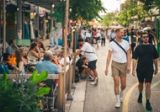
      ⬆️ We’ve come a long way: Here’s some of the vibes at PlazaPalooza in 2025. | Photograph: Bruno Destombes

      The ground beneath our feet

      Before the street, there was limestone. The territory that would become Petite-Patrie and one of Montreal's most commercially restless arteries sat at one of the highest elevations on the island, its soil rich in calcite rock that kept quarry workers busy for generations. The population was largely francophone and Catholic, working the land or cutting stone.

      Comments

      Welcome to The Main's comments section!

      Share your thoughts and join the conversation. Please be respectful and constructive.

      No comments yet. Be the first!

      Follow on Google
      History Lesson

      Everyone's Street, Nobody's Neighbourhood: The Story of Plaza St-Hubert

      The 200-year story of a street that's always belonged to everyone and no one.

      ByJ.P. Karwacki

      June 12, 2026 · 7 min read

      Everyone's Street, Nobody's Neighbourhood: The Story of Plaza St-Hubert
      Plaza Saint-Hubert in 1966. | Photograph: Archives de la Ville de Montréal / VM94-AD103-001

      The Main is reader-supported. Subscriptions are what keep us independent. Five dollars a month — the restaurants, the guides, the weekly bulletin, and what to do each weekend. Support us today.

      Branded content

      This is branded content, made possible by a vetted partner.

      Presented by

      Plaza St-Hubert

      Discover the places mentioned in this story

      Épicerie Conserva

      Each summer, Plaza St-Hubert’s commercial stretch closes to cars and fills up with people hitting pavement populated by the now-annual festival PlazaPalooza, back from July 9 to 12 for its 4th edition in 2026. The programme will see everything from rock and hip-hop to Latin rhythms as vendors set up open-air shops. The event will welcome families, regulars, and newcomers to explore the street’s vast array of merchants.

      That festival’s wild and varied because it’s true to this street. It’s a street that doesn't have a single identity, and never did. It has Lebanese bridal merchants and Colombian bakeries, cowboy boot dealers and zero-waste pubs, decades-old smoked meat counters and bars for French expats. You can buy yourself a steampunk costume, jars of custom pizza chili crisp, a limited edition vinyl print, and a bite of nationally-lauded fine dining in the same afternoon.

      Walk it end to end and you'll pass storefronts in at least four languages, buildings from four different decades, and people who have nothing obvious in common except that they are all, quite simply, here.

      ⬆️ We’ve come a long way: Here’s some of the vibes at PlazaPalooza in 2025. | Photograph: Bruno Destombes

      The ground beneath our feet

      Before the street, there was limestone. The territory that would become Petite-Patrie and one of Montreal's most commercially restless arteries sat at one of the highest elevations on the island, its soil rich in calcite rock that kept quarry workers busy for generations. The population was largely francophone and Catholic, working the land or cutting stone.

      Comments

      Welcome to The Main's comments section!

      Share your thoughts and join the conversation. Please be respectful and constructive.

      No comments yet. Be the first!

      Follow on Google

      Each summer, Plaza St-Hubert’s commercial stretch closes to cars and fills up with people hitting pavement populated by the now-annual festival PlazaPalooza, back from July 9 to 12 for its 4th edition in 2026. The programme will see everything from rock and hip-hop to Latin rhythms as vendors set up open-air shops. The event will welcome families, regulars, and newcomers to explore the street’s vast array of merchants.

      That festival’s wild and varied because it’s true to this street. It’s a street that doesn't have a single identity, and never did. It has Lebanese bridal merchants and Colombian bakeries, cowboy boot dealers and zero-waste pubs, decades-old smoked meat counters and bars for French expats. You can buy yourself a steampunk costume, jars of custom pizza chili crisp, a limited edition vinyl print, and a bite of nationally-lauded fine dining in the same afternoon.

      Walk it end to end and you'll pass storefronts in at least four languages, buildings from four different decades, and people who have nothing obvious in common except that they are all, quite simply, here.

      ⬆️ We’ve come a long way: Here’s some of the vibes at PlazaPalooza in 2025. | Photograph: Bruno Destombes

      The ground beneath our feet

      Before the street, there was limestone. The territory that would become Petite-Patrie and one of Montreal's most commercially restless arteries sat at one of the highest elevations on the island, its soil rich in calcite rock that kept quarry workers busy for generations. The population was largely francophone and Catholic, working the land or cutting stone.

      The street itself began to take shape in the 1820s, when merchant Hubert-Joseph Lacroix ceded land for its opening (which is believed to be where the name Saint-Hubert originates). For decades it remained more of an aspiration than an artery; a line on a plan waiting for the conditions that would make it real.

      Those conditions arrived in stages: The CP Rail line cut through in 1878, drawing workers and families north of the tracks. The electric tramway followed in 1893, and with it came Irish, Ukrainian, and Italian immigrants who would quadruple the neighbourhood's population within a few years and lay the groundwork for the multiethnic character that defines it to this day. By the early 1900s, Saint-Hubert was already one of the most commercially active streets in the northern part of the city.

      Plaza Saint-Hubert in 1937. | Photograph: Archives de la Ville de Montréal / VM94-Z179-002

      By the time the bus line C began running along Saint-Hubert in the mid-1920s, the street had already accumulated depth of commercial character. Families planted flags through generational retail, such as Librairie Raffin which dates back to 1930. The Théâtre Plaza arrived in 1922, and was among the most lavish movie houses in the city; it closed at the end of the 1970s, but reopened with a restored facade in 2003 as the multidisciplinary performance venue it remains today, one of the few surviving examples of that era's grand cinema architecture in Montreal.

      Then came September 25, 1951: Hélène and René Léger opened a 78-seat rotisserie named with admirable straightforwardness after the street it sat on. The following year they launched what is believed to be Canada's first free home delivery service, their yellow fleet of Volkswagen Beetles becoming a fixture of the neighbourhood. A great neon rooster sign would eventually crown the building, an advertisement signalling that Saint-Hubert had arrived.

      St-Hubert Street in 1961. | Photograph: Yvon Bellemare / Archives de la Ville de Montréal / VM94-A0032-011

      The Golden Age

      The Plaza as the institution the city knows it today was officially born in 1959, following the merchants' association forming around 1954 to defend independent businesses against the rising pressure of suburban shopping malls. It adopted the name and announced a new vision for the street.

      In the 1960s, Saint-Hubert was one of the busiest commercial strips in the city. The writer Claude Jasmin, who grew up in the neighbourhood and later immortalised it in his 1972 memoir La Petite-Patrie, recalled the street in its heyday as something closer to a social institution than a shopping destination, somewhere you got dressed up, went to be seen, and maybe fell in love with someone working a boutique counter.

      The era's biggest Québécois entertainers—Claude Blanchard, Fernand Gignac, Suzanne Lapointe, Raymond Lévesque among them—performed regularly along the strip, and the Plaza became the first commercial association in Montreal to advertise on the then-newly launched private television station Télé-Métropole. The popular quiz show Dix sur dix went further, bringing the Plaza’s name into living rooms across the city and gave viewers the chance to win prizes from boutiques. The first Christmas parades ran down Saint-Hubert in those years too, beginning an annual tradition. Families came from across Quebec to experience it all.

      The first sidewalk sale, held in 1973, was reportedly a first of its kind in Quebec as a community gathering built into the commercial calendar that would eventually evolve, decades later, into the present-day PlazaPalooza.

      Photograph: Archives de la Ville de Montréal / VM94-U3139-001

      Visions and realities

      Here is where the Plaza's story gets interesting in a way that most commercial streets' don't: In 1959, the same year the association adopted its name, merchants unveiled an ambitious redesign that would pedestrianize Saint-Hubert entirely, tear down the buildings on parallel streets, and replace them with parking for 4,000 cars (roughly one square foot of parking for every square foot of retail). The plan was partially adopted with some parking and decorative arches installed, but the grand vision never materialized.

      The debate continued for decades. In the early 1970s, planners floated schemes to extend the Plaza east to west and connect it directly to the Beaubien and Jean-Talon metro stations. A fully enclosed mall, like Quebec City's Mail Saint-Roch, was seriously considered before practical problems like snow load, ventilation, and emergency access killed it. A proposal to heat the sidewalks to solve the snow removal problem went nowhere.

      Instead, in 1984, the marquise arrived: a 1.2-kilometre glass and metal canopy sheltering both sidewalks of the street. It was immediately controversial, with Heritage Montreal's then-executive director calling it a uniform, monotonous structure that obliterated the diversity of the buildings beneath it. It won a prix citron in urban design, but people complained that it cut off second-storey balconies and darkened apartment windows. Loved or despised, the street had its signature.

      Photograph: Archives de la Ville de Montréal / VM94-U3139-001

      Lean years and the lifeline

      The 1980s and 90s were hard on Saint-Hubert in ways that felt, at the time, possibly terminal. Mall culture was winning and suburban competition was fierce while parking remained a persistent problem. Then there was the age-old problem of generations of long-standing merchants approaching retirement without obvious successors.

      But this is the part that gets undersold: What saved the street was partly the bridal trade, and the communities that built it. Through the 1980s, waves of new arrivals, many from Lebanon, Latin America, Haiti, and Vietnam, settled in Petite-Patrie and made the Plaza their own commercial territory. The wedding dress district that the rest of the city has always found faintly ridiculous for its taffeta, paillettes, and quinceañera gowns in the windows was a genuine economic lifeline.

      "It's kitsch," SDC director general Mike Parente told Voir in 2010. "It draws mockery from people acting in bad faith, but it's what drives the commercial strength of the artery and it's part of Montreal's history." By that point, roughly 70 merchants on the Plaza depended on the events trade of weddings, proms, and quinceañeras—and they drew in customers from across the province in doing so.

      Holding it all together was the SDC, founded in 1981, making it one of Quebec's oldest commercial development groups. Its role through the lean decades was quiet but essential as it kept the membership united, ran the events calendar, and advocated for the street's interests. Small initiatives like a 15-minute parking program or public washrooms addressed the practical frictions that had long chipped away at foot traffic.

      When the city finally began planning a major overhaul of the street with a rebuild that would have offered the perfect opportunity to remove the marquise for good, a 2012 consultation found that more than 80% of merchants and customers wanted to keep it. The structure had, characteristically, become part of the place whether anyone had planned it that way or not.

      From 2018 to 2020, that overhaul arrived with underground pipes, new sidewalks, and a lighter, contemporary, steel and glass marquise that remade the street from the ground up. The Plaza emerged better positioned than it had been in decades as renovated, more pedestrian-friendly, and attracting new waves of merchants who saw the potential before the dust had settled. By the time the canopy was in place, occupancy had climbed to around 95%. The street had absorbed the disruption handily.

      Photograph: Bruno Destombes

      Whoever shows up next

      Which brings us back to the present day’s annual festivities.

      PlazaPalooza doesn't try to define what the Plaza is. It books DVTR and Alix Fernz for Thursday, a live Love & Hip-Hop concert broadcast on ICI Musique Hip-Hop for Friday, La Murga and a 100lux dance battle for Saturday, and a family-oriented program for Sunday. It runs Lurlu Coop's bike repair workshops alongside community organisation booths and a sidewalk sale spotlighting more than 400 local entrepreneurs. It is, in other words, a festival that looks exactly like the street it's celebrating: eclectic, unpretentious, and impossible to reduce to a single identity.

      "It's a weird street," Épicerie Conserva’s Massimo Vincelli once said of the Plaza. "You can walk it a hundred times and still find something you've never noticed." That's as close to a thesis statement as the place has ever produced, and it comes from someone who's been on it every day for years.

      The limestone and tramways are long gone, as are the neon rooster and cabaret singers. The street has since lived through many lives, from a speculator's dream and working-class hub to a cinema destination, a bridal district, and a construction site. Each community that’s arrived here has made it their own without ever quite closing it off to whoever came next. No single vision or generation ever got to keep it, but that's what’s kept it alive.

      Every summer, someone will turn up the music as the street closes to cars for PlazaPalooza, and the Plaza will do what it has always done: make room for anyone who wants to show up.

      Photograph: Bruno Destombes

      The 4th edition of PlazaPalooza runs July 9 to 12, 2026 on Plaza St-Hubert. Admission is free.

      Each summer, Plaza St-Hubert’s commercial stretch closes to cars and fills up with people hitting pavement populated by the now-annual festival PlazaPalooza, back from July 9 to 12 for its 4th edition in 2026. The programme will see everything from rock and hip-hop to Latin rhythms as vendors set up open-air shops. The event will welcome families, regulars, and newcomers to explore the street’s vast array of merchants.

      That festival’s wild and varied because it’s true to this street. It’s a street that doesn't have a single identity, and never did. It has Lebanese bridal merchants and Colombian bakeries, cowboy boot dealers and zero-waste pubs, decades-old smoked meat counters and bars for French expats. You can buy yourself a steampunk costume, jars of custom pizza chili crisp, a limited edition vinyl print, and a bite of nationally-lauded fine dining in the same afternoon.

      Walk it end to end and you'll pass storefronts in at least four languages, buildings from four different decades, and people who have nothing obvious in common except that they are all, quite simply, here.

      ⬆️ We’ve come a long way: Here’s some of the vibes at PlazaPalooza in 2025. | Photograph: Bruno Destombes

      The ground beneath our feet

      Before the street, there was limestone. The territory that would become Petite-Patrie and one of Montreal's most commercially restless arteries sat at one of the highest elevations on the island, its soil rich in calcite rock that kept quarry workers busy for generations. The population was largely francophone and Catholic, working the land or cutting stone.

      The street itself began to take shape in the 1820s, when merchant Hubert-Joseph Lacroix ceded land for its opening (which is believed to be where the name Saint-Hubert originates). For decades it remained more of an aspiration than an artery; a line on a plan waiting for the conditions that would make it real.

      Those conditions arrived in stages: The CP Rail line cut through in 1878, drawing workers and families north of the tracks. The electric tramway followed in 1893, and with it came Irish, Ukrainian, and Italian immigrants who would quadruple the neighbourhood's population within a few years and lay the groundwork for the multiethnic character that defines it to this day. By the early 1900s, Saint-Hubert was already one of the most commercially active streets in the northern part of the city.

      Plaza Saint-Hubert in 1937. | Photograph: Archives de la Ville de Montréal / VM94-Z179-002

      By the time the bus line C began running along Saint-Hubert in the mid-1920s, the street had already accumulated depth of commercial character. Families planted flags through generational retail, such as Librairie Raffin which dates back to 1930. The Théâtre Plaza arrived in 1922, and was among the most lavish movie houses in the city; it closed at the end of the 1970s, but reopened with a restored facade in 2003 as the multidisciplinary performance venue it remains today, one of the few surviving examples of that era's grand cinema architecture in Montreal.

      Then came September 25, 1951: Hélène and René Léger opened a 78-seat rotisserie named with admirable straightforwardness after the street it sat on. The following year they launched what is believed to be Canada's first free home delivery service, their yellow fleet of Volkswagen Beetles becoming a fixture of the neighbourhood. A great neon rooster sign would eventually crown the building, an advertisement signalling that Saint-Hubert had arrived.

      St-Hubert Street in 1961. | Photograph: Yvon Bellemare / Archives de la Ville de Montréal / VM94-A0032-011

      The Golden Age

      The Plaza as the institution the city knows it today was officially born in 1959, following the merchants' association forming around 1954 to defend independent businesses against the rising pressure of suburban shopping malls. It adopted the name and announced a new vision for the street.

      In the 1960s, Saint-Hubert was one of the busiest commercial strips in the city. The writer Claude Jasmin, who grew up in the neighbourhood and later immortalised it in his 1972 memoir La Petite-Patrie, recalled the street in its heyday as something closer to a social institution than a shopping destination, somewhere you got dressed up, went to be seen, and maybe fell in love with someone working a boutique counter.

      The era's biggest Québécois entertainers—Claude Blanchard, Fernand Gignac, Suzanne Lapointe, Raymond Lévesque among them—performed regularly along the strip, and the Plaza became the first commercial association in Montreal to advertise on the then-newly launched private television station Télé-Métropole. The popular quiz show Dix sur dix went further, bringing the Plaza’s name into living rooms across the city and gave viewers the chance to win prizes from boutiques. The first Christmas parades ran down Saint-Hubert in those years too, beginning an annual tradition. Families came from across Quebec to experience it all.

      The first sidewalk sale, held in 1973, was reportedly a first of its kind in Quebec as a community gathering built into the commercial calendar that would eventually evolve, decades later, into the present-day PlazaPalooza.

      Photograph: Archives de la Ville de Montréal / VM94-U3139-001

      Visions and realities

      Here is where the Plaza's story gets interesting in a way that most commercial streets' don't: In 1959, the same year the association adopted its name, merchants unveiled an ambitious redesign that would pedestrianize Saint-Hubert entirely, tear down the buildings on parallel streets, and replace them with parking for 4,000 cars (roughly one square foot of parking for every square foot of retail). The plan was partially adopted with some parking and decorative arches installed, but the grand vision never materialized.

      The debate continued for decades. In the early 1970s, planners floated schemes to extend the Plaza east to west and connect it directly to the Beaubien and Jean-Talon metro stations. A fully enclosed mall, like Quebec City's Mail Saint-Roch, was seriously considered before practical problems like snow load, ventilation, and emergency access killed it. A proposal to heat the sidewalks to solve the snow removal problem went nowhere.

      Instead, in 1984, the marquise arrived: a 1.2-kilometre glass and metal canopy sheltering both sidewalks of the street. It was immediately controversial, with Heritage Montreal's then-executive director calling it a uniform, monotonous structure that obliterated the diversity of the buildings beneath it. It won a prix citron in urban design, but people complained that it cut off second-storey balconies and darkened apartment windows. Loved or despised, the street had its signature.

      Photograph: Archives de la Ville de Montréal / VM94-U3139-001

      Lean years and the lifeline

      The 1980s and 90s were hard on Saint-Hubert in ways that felt, at the time, possibly terminal. Mall culture was winning and suburban competition was fierce while parking remained a persistent problem. Then there was the age-old problem of generations of long-standing merchants approaching retirement without obvious successors.

      But this is the part that gets undersold: What saved the street was partly the bridal trade, and the communities that built it. Through the 1980s, waves of new arrivals, many from Lebanon, Latin America, Haiti, and Vietnam, settled in Petite-Patrie and made the Plaza their own commercial territory. The wedding dress district that the rest of the city has always found faintly ridiculous for its taffeta, paillettes, and quinceañera gowns in the windows was a genuine economic lifeline.

      "It's kitsch," SDC director general Mike Parente told Voir in 2010. "It draws mockery from people acting in bad faith, but it's what drives the commercial strength of the artery and it's part of Montreal's history." By that point, roughly 70 merchants on the Plaza depended on the events trade of weddings, proms, and quinceañeras—and they drew in customers from across the province in doing so.

      Holding it all together was the SDC, founded in 1981, making it one of Quebec's oldest commercial development groups. Its role through the lean decades was quiet but essential as it kept the membership united, ran the events calendar, and advocated for the street's interests. Small initiatives like a 15-minute parking program or public washrooms addressed the practical frictions that had long chipped away at foot traffic.

      When the city finally began planning a major overhaul of the street with a rebuild that would have offered the perfect opportunity to remove the marquise for good, a 2012 consultation found that more than 80% of merchants and customers wanted to keep it. The structure had, characteristically, become part of the place whether anyone had planned it that way or not.

      From 2018 to 2020, that overhaul arrived with underground pipes, new sidewalks, and a lighter, contemporary, steel and glass marquise that remade the street from the ground up. The Plaza emerged better positioned than it had been in decades as renovated, more pedestrian-friendly, and attracting new waves of merchants who saw the potential before the dust had settled. By the time the canopy was in place, occupancy had climbed to around 95%. The street had absorbed the disruption handily.

      Photograph: Bruno Destombes

      Whoever shows up next

      Which brings us back to the present day’s annual festivities.

      PlazaPalooza doesn't try to define what the Plaza is. It books DVTR and Alix Fernz for Thursday, a live Love & Hip-Hop concert broadcast on ICI Musique Hip-Hop for Friday, La Murga and a 100lux dance battle for Saturday, and a family-oriented program for Sunday. It runs Lurlu Coop's bike repair workshops alongside community organisation booths and a sidewalk sale spotlighting more than 400 local entrepreneurs. It is, in other words, a festival that looks exactly like the street it's celebrating: eclectic, unpretentious, and impossible to reduce to a single identity.

      "It's a weird street," Épicerie Conserva’s Massimo Vincelli once said of the Plaza. "You can walk it a hundred times and still find something you've never noticed." That's as close to a thesis statement as the place has ever produced, and it comes from someone who's been on it every day for years.

      The limestone and tramways are long gone, as are the neon rooster and cabaret singers. The street has since lived through many lives, from a speculator's dream and working-class hub to a cinema destination, a bridal district, and a construction site. Each community that’s arrived here has made it their own without ever quite closing it off to whoever came next. No single vision or generation ever got to keep it, but that's what’s kept it alive.

      Every summer, someone will turn up the music as the street closes to cars for PlazaPalooza, and the Plaza will do what it has always done: make room for anyone who wants to show up.

      Photograph: Bruno Destombes

      The 4th edition of PlazaPalooza runs July 9 to 12, 2026 on Plaza St-Hubert. Admission is free.
      The Main

      Latest from The Main

      DesignFormat MTL Marks a Resurgence in Montreal’s Design SceneNewsletterThe Bulletin: The (Best) Worst Movie Ever Made, Racing Around the Mountain, Burlesque Birthdays, and Digital Pollution [Issue #198]Arts & CultureMandy Benoualid Wants You to Plan Your DeathBeyond MontrealDust, Blood, and Gravel: A Wild Ride Through L’Enfer des PatriotesFood & DrinkLe Grand Comité Is a Neighbourhood Bistro Upstairs (With a Secret Society Down Below)
      The Main

      Latest from The Main

      DesignFormat MTL Marks a Resurgence in Montreal’s Design SceneNewsletterThe Bulletin: The (Best) Worst Movie Ever Made, Racing Around the Mountain, Burlesque Birthdays, and Digital Pollution [Issue #198]Arts & CultureMandy Benoualid Wants You to Plan Your DeathBeyond MontrealDust, Blood, and Gravel: A Wild Ride Through L’Enfer des PatriotesFood & DrinkLe Grand Comité Is a Neighbourhood Bistro Upstairs (With a Secret Society Down Below)
      Related Guides
      The best Montreal shops to kickstart the year
      The best Montreal shops to kickstart the yearGuide · 23 places
      The Main’s Guide to Plaza St-Hubert
      The Main’s Guide to Plaza St-HubertGuide · 32 places
      Pony's guide to Plaza Saint-Hubert
      Pony's guide to Plaza Saint-HubertGuide · 8 places
      Related Guides
      The best Montreal shops to kickstart the year
      The best Montreal shops to kickstart the yearGuide · 23 places
      The Main’s Guide to Plaza St-Hubert
      The Main’s Guide to Plaza St-HubertGuide · 32 places
      Pony's guide to Plaza Saint-Hubert
      Pony's guide to Plaza Saint-HubertGuide · 8 places
      The Crate-Diggers Have Spoken: Six Record Shops on the Jazz Fest Shows They Want to See

      Previous

      The Crate-Diggers Have Spoken: Six Record Shops on the Jazz Fest Shows They Want to See

      Next

      ECHO is Cirque du Soleil's New Show About the End of the World (Sort Of)

      ECHO is Cirque du Soleil's New Show About the End of the World (Sort Of)
      The Crate-Diggers Have Spoken: Six Record Shops on the Jazz Fest Shows They Want to See

      Previous

      The Crate-Diggers Have Spoken: Six Record Shops on the Jazz Fest Shows They Want to See

      Next

      ECHO is Cirque du Soleil's New Show About the End of the World (Sort Of)

      ECHO is Cirque du Soleil's New Show About the End of the World (Sort Of)

      More History Lesson

      Before BYOB Became a Fixture of Dining Out, It Was a Loophole
      History Lesson
      J.P. Karwacki

      Before BYOB Became a Fixture of Dining Out, It Was a Loophole

      Behind Quebec’s bring-your-own-wine restaurants is a decades-old conflict between cheaper nights out and the economics of staying open.

      How Milton-Parc Turned a Fight Against Demolition Into a Radical Housing Experiment
      History Lesson
      J.P. Karwacki

      How Milton-Parc Turned a Fight Against Demolition Into a Radical Housing Experiment

      North America’s largest non-profit housing community grew out of decades of tenant organizing. Half a century later, there is still nothing else like it.

      From a Patriotic Temple for French Canada to Canada’s Longest-Running Theatre
      History Lesson
      J.P. Karwacki

      From a Patriotic Temple for French Canada to Canada’s Longest-Running Theatre

      Opened unfinished and deep in debt in 1893, the Monument-National went on to host Yiddish theatre, Chinese opera, public education, and generations of performers.

      The Invention and Afterlife of Expo 67’s “Man and His World”
      History Lesson
      J.P. Karwacki

      The Invention and Afterlife of Expo 67’s “Man and His World”

      On the origins of Expo’s grand humanist theme, and how it lived on for 17 strange summers after the fair ended.

      On Queer Bars, Police Raids, and Disappearing Dance Floors
      History Lesson
      J.P. Karwacki

      On Queer Bars, Police Raids, and Disappearing Dance Floors

      The nightlife of clandestine cabarets and roving parties alike created essential queer space of belonging and resistance over generations in Montreal.

      The Legacy of the 1976 Olympics Goes Way Beyond a Stadium
      History Lesson
      Romy Shoam, in special collaboration with Héritage Montréal

      The Legacy of the 1976 Olympics Goes Way Beyond a Stadium

      Fifty years later, Montreal’s forgotten Olympic infrastructure hides in plain sight.

      More History Lesson

      Before BYOB Became a Fixture of Dining Out, It Was a Loophole
      History Lesson
      J.P. Karwacki

      Before BYOB Became a Fixture of Dining Out, It Was a Loophole

      Behind Quebec’s bring-your-own-wine restaurants is a decades-old conflict between cheaper nights out and the economics of staying open.

      How Milton-Parc Turned a Fight Against Demolition Into a Radical Housing Experiment
      History Lesson
      J.P. Karwacki

      How Milton-Parc Turned a Fight Against Demolition Into a Radical Housing Experiment

      North America’s largest non-profit housing community grew out of decades of tenant organizing. Half a century later, there is still nothing else like it.

      From a Patriotic Temple for French Canada to Canada’s Longest-Running Theatre
      History Lesson
      J.P. Karwacki

      From a Patriotic Temple for French Canada to Canada’s Longest-Running Theatre

      Opened unfinished and deep in debt in 1893, the Monument-National went on to host Yiddish theatre, Chinese opera, public education, and generations of performers.

      The Invention and Afterlife of Expo 67’s “Man and His World”
      History Lesson
      J.P. Karwacki

      The Invention and Afterlife of Expo 67’s “Man and His World”

      On the origins of Expo’s grand humanist theme, and how it lived on for 17 strange summers after the fair ended.

      On Queer Bars, Police Raids, and Disappearing Dance Floors
      History Lesson
      J.P. Karwacki

      On Queer Bars, Police Raids, and Disappearing Dance Floors

      The nightlife of clandestine cabarets and roving parties alike created essential queer space of belonging and resistance over generations in Montreal.

      The Legacy of the 1976 Olympics Goes Way Beyond a Stadium
      History Lesson
      Romy Shoam, in special collaboration with Héritage Montréal

      The Legacy of the 1976 Olympics Goes Way Beyond a Stadium

      Fifty years later, Montreal’s forgotten Olympic infrastructure hides in plain sight.

      Related Classics

      From our archive.

      When Montreal had a steam-powered shortcut to the top of Mount Royal
      History Lesson
      J.P. Karwacki

      When Montreal Had a Steam-powered Shortcut to the Top of Mount Royal

      From 1884 to 1918, a steam-powered cable railway hauled Montrealers to the summit in minutes, despite a park designer's vision of leisurely mountain strolls.

      What Happened to Frederick Law Olmsted’s Vision for Mount Royal?
      History Lesson
      J.P. Karwacki

      What Happened to Frederick Law Olmsted’s Vision for Mount Royal?

      As Mount Royal Park turns 150, the story of its creation reveals how Olmsted's vision for the mountain was compromised almost from the very beginning.

      The Day the Décarie Became a River
      History Lesson
      J.P. Karwacki

      The Day the Décarie Became a River

      On July 14, 1987, two hours of rain drowned the Décarie, shut down the métro, and became the storm so many Montreal floods are still measured against.

      When McGill med students went grave-robbing for science
      History Lesson
      J.P. Karwacki

      When McGill Med Students Went Grave-robbing for Science

      The law demanded they learn anatomy but made dissection illegal, so for nearly a century, stolen corpses were tobogganed down Mount Royal to a folk hero janitor who paid cash, no questions asked.

      The century-long smoked meat legacy of Schwartz's Deli
      History Lesson
      J.P. Karwacki

      The Century-long Smoked Meat Legacy of Schwartz's Deli

      How a Romanian immigrant's recipe and stubborn refusal to change built Montreal's most iconic sandwich.

      How a Railway Porter Built Montreal's Most Storied Jazz Club
      History Lesson
      J.P. Karwacki

      How a Railway Porter Built Montreal's Most Storied Jazz Club

      The story of Rufus Rockhead, the Jamaican-born railway porter who built Montreal's most legendary jazz club—and spent decades defending it.

      Related Classics

      From our archive.

      When Montreal had a steam-powered shortcut to the top of Mount Royal
      History Lesson
      J.P. Karwacki

      When Montreal Had a Steam-powered Shortcut to the Top of Mount Royal

      From 1884 to 1918, a steam-powered cable railway hauled Montrealers to the summit in minutes, despite a park designer's vision of leisurely mountain strolls.

      What Happened to Frederick Law Olmsted’s Vision for Mount Royal?
      History Lesson
      J.P. Karwacki

      What Happened to Frederick Law Olmsted’s Vision for Mount Royal?

      As Mount Royal Park turns 150, the story of its creation reveals how Olmsted's vision for the mountain was compromised almost from the very beginning.

      The Day the Décarie Became a River
      History Lesson
      J.P. Karwacki

      The Day the Décarie Became a River

      On July 14, 1987, two hours of rain drowned the Décarie, shut down the métro, and became the storm so many Montreal floods are still measured against.

      When McGill med students went grave-robbing for science
      History Lesson
      J.P. Karwacki

      When McGill Med Students Went Grave-robbing for Science

      The law demanded they learn anatomy but made dissection illegal, so for nearly a century, stolen corpses were tobogganed down Mount Royal to a folk hero janitor who paid cash, no questions asked.

      The century-long smoked meat legacy of Schwartz's Deli
      History Lesson
      J.P. Karwacki

      The Century-long Smoked Meat Legacy of Schwartz's Deli

      How a Romanian immigrant's recipe and stubborn refusal to change built Montreal's most iconic sandwich.

      How a Railway Porter Built Montreal's Most Storied Jazz Club
      History Lesson
      J.P. Karwacki

      How a Railway Porter Built Montreal's Most Storied Jazz Club

      The story of Rufus Rockhead, the Jamaican-born railway porter who built Montreal's most legendary jazz club—and spent decades defending it.