
How the Atwater Market fed Montreal through depression and renewal

A civic monument, a neighbourhood anchor, and a living archive of what Montreal eats since 1933.

J.P. Karwacki

J.P. Karwacki

18 juillet 2025- Read time: 8 min
How the Atwater Market fed Montreal through depression and renewal

Built during the leanest years of the Great Depression, Atwater Market was always meant to be more than a place to buy food.

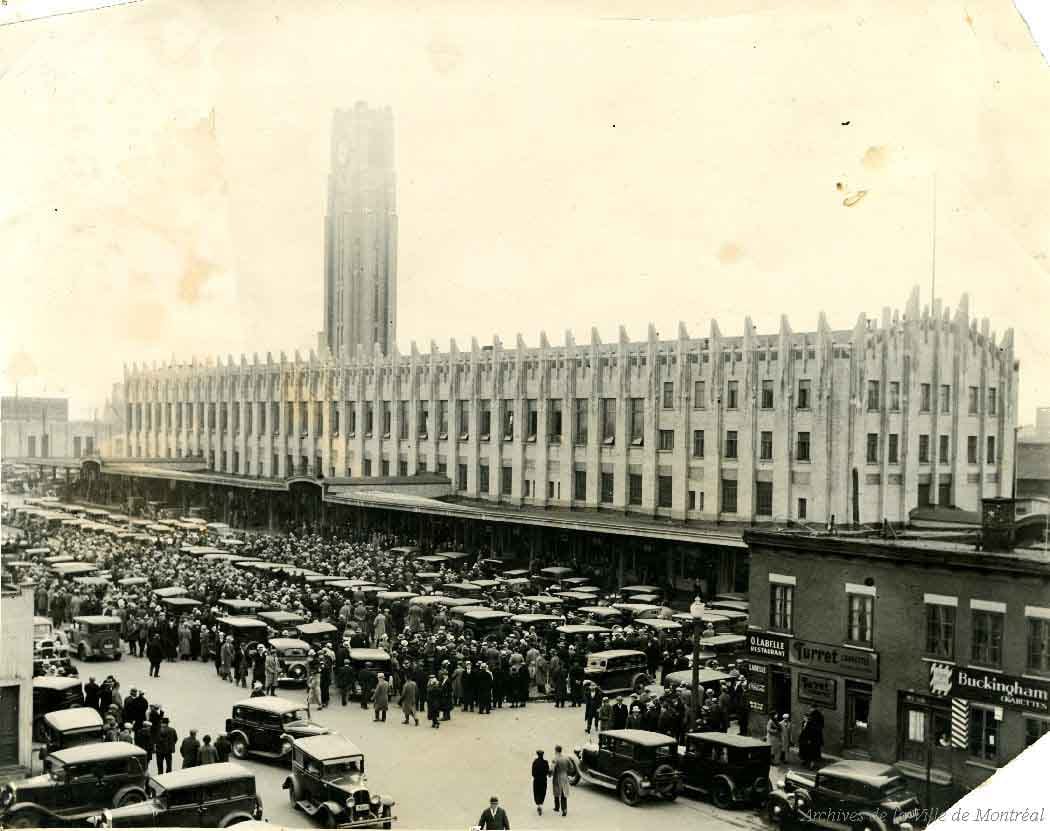
When it opened its doors in 1933, it was pitched as a civic marvel: modern, hygienic, and forward-looking. A million-dollar investment by the City of Montreal, the Art Deco building was part social infrastructure, part economic stimulus.

The market took its name from Edwin Atwater, a 19th-century businessman and alderman, and replaced the old St. Antoine Market a few blocks east. Designed by father-son architects Ludger and Paul Lemieux, it featured a refrigerated interior, public weighing scales, and a third-floor hall big enough to hold 10,000 people. Over the decades, it hosted political rallies, wrestling matches, WWII food stockpiles, and a campaign against conscription that drew crowds of 20,000.

Article réservé aux membres

Découvrez Montréal autrement. Rejoignez la communauté The Main.

Lisez cet article gratuitement.

Entrez votre courriel pour débloquer votre premier article et recevoir The Bulletin, notre infolettre sur la bouffe, l’art et la culture locale.

  • 5 articles gratuits par mois
  • Sauvegardez vos adresses et guides
  • Infolettre hebdo The Main Brief
  • Restez branché sur la culture montréalaise

Allez plus loin. Devenez Insider.

Faites partie d’une communauté qui soutient les histoires montréalaises indépendantes et célèbre les gens qui font vivre la culture.

Subscribe
  • Accès illimité à tous les articles
  • Contenu exclusif & perspectives locales
  • Offres spéciales et invitations à nos événements
  • 10 % de rabais à la boutique
  • Soutenez les médias locaux indépendants

Déjà membre? Se connecter

Related articles

Get to the heart of Montreal's Latino communities through a single grocery store
Version Anglaise
J.P. Karwacki

Get to the heart of Montreal's Latino communities through a single grocery store

For decades, Sabor Latino's been the gravitational centre for Montreal's Latino communities.

Ruby Foo's was an absolute legend of a Chinese restaurant
Version Anglaise
J.P. Karwacki

Ruby Foo's was an absolute legend of a Chinese restaurant

From its 1945 opening to a 1984 closure and its present-day hotel, the Décarie Boulevard institution was where Montreal went to see and be seen.

Montreal Pool Room: Serving a city's hot dogs for over a century
Version Anglaise
J.P. Karwacki

Montreal Pool Room: Serving a city's hot dogs for over a century

How a Bulgarian immigrant's billiard hall became one of Montreal's most enduring institutions, from pimp steaks to late night eats infamy.

NDG's Empress Theatre survived a century of change. Can it survive neglect?
Version Anglaise
Kaitlyn DiBartolo

NDG's Empress Theatre survived a century of change. Can it survive neglect?

Montreal's last (and Canada's only) Egyptian Revival movie palace reinvented itself for decades. Now it's been empty for 33 years.

When McGill med students went grave-robbing for science
Version Anglaise
J.P. Karwacki

When McGill med students went grave-robbing for science

The law demanded they learn anatomy but made dissection illegal, so for nearly a century, stolen corpses were tobogganed down Mount Royal to a folk hero janitor who paid cash, no questions asked.

How Little Portugal carved out its place in the Plateau
Version Anglaise
Phylida Tuff-West

How Little Portugal carved out its place in the Plateau

From postwar migration to piri piri chicken, Azorean immigrants transformed an iconic Montreal neighbourhood with enduring community.